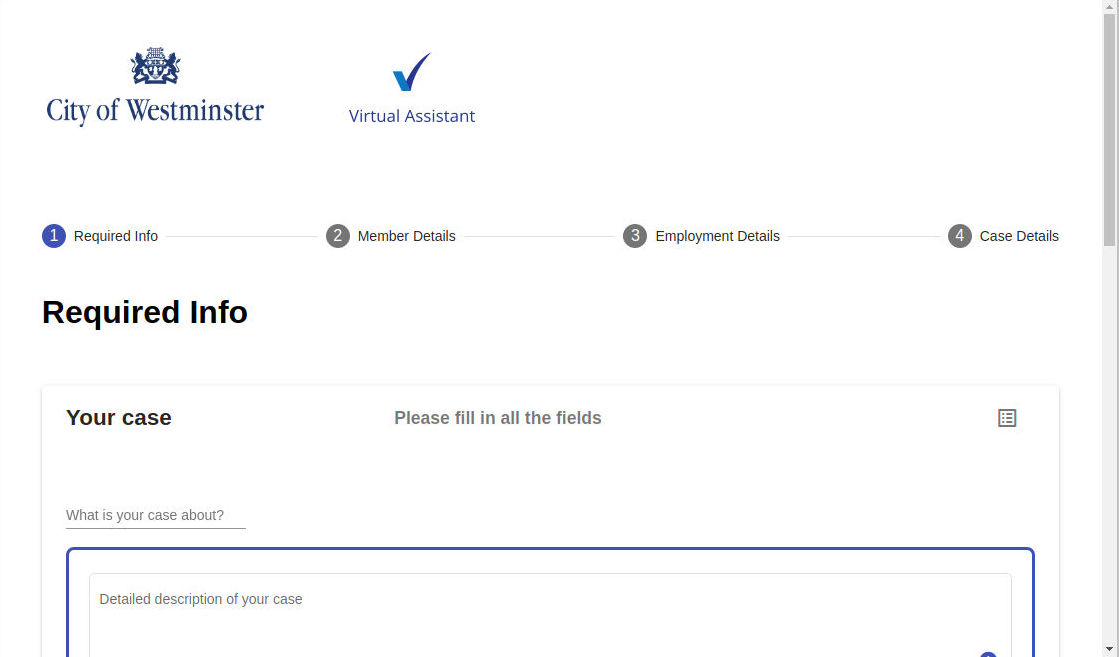
1. The Challenge: Digitising Complex Public-Sector Workflows
The Westminster City Council pension office handled a very high volume of requests. Citizens frequently visited the office in person because paper forms were confusing, and processing times stretched on.
Our objective was to create an intuitive web application capable of guiding any citizen through the entire application process step by step, validating data in real time, generating pre-filled PDF documents, and submitting them directly to the relevant department — all without a single in-person visit.
2. The System Architecture: Angular Front-End + Custom PHP Backend
We designed a two-tier architecture optimised for reliability, accessibility, and document automation:
Guided Form Wizard: A multi-step Angular front-end with contextual help, conditional field logic, and real-time validation that adapts to each citizen's answers.
Custom PHP Backend: A bespoke server-side framework for form processing, eligibility rule evaluation, PDF generation, and secure document routing.
Automated PDF Pipeline: Dynamic document generation with pre-filled citizen data, digital signature, and automatic submission.
Email Notification System: Automated confirmations and status updates sent to citizens at every stage of the application lifecycle.
Key Architectural Takeaways
- Step-by-step guided wizards with conditional logic dramatically reduce the support burden on council staff.
- Real-time client-side validation combined with server-side business rule enforcement virtually eliminates submission errors.
- Automated PDF generation with pre-filled data removes the bottleneck of manual document preparation in government workflows.
- Building on Angular with a custom PHP backend provided the right balance of interactive UX and reliable server-side processing for document-heavy applications.

Marco Pileri
Marco leads software architecture and AI engineering at Intelli Design, architecting enterprise platforms for global brands and public-sector organisations.